
This report is the result of a diverse range of stakeholders’ using ‘futures thinking’ tools and methods to examine the complexities of introducing electric vehicles (EVs) to Southern Africa and the tensions that might arise in creating more desired re …
The global energy landscape has changed dramatically over the past 25 years, but there are potentially much larger and rapid changes in store in the future. Resources for the Future recently released a game-changing report1 that compares “apples-with-a …
The circular economy approach to sustainable economic development has in recent years gained traction and is now included in the European Union’s Green Deal committing the EU to becoming carbon neutral by 2050. African countries practice aspects of the …
Electric Vehicles (EVs) are not typically seen as catalysts that may enable the large-scale transformation of national and regional economic and development trajectories. But the climate emergency, the Fourth Industrial Revolution’s disruptive impact, …
The EU–SADC economic partnership agreement (EPA) came into force in October 2016 and offers Lesotho a number of tariff preferences above competitor countries in the EU market. These preferences become more significant the more processed a product is. T …
Six SADC member states negotiated an economic partnership agreement (EPA) with the EU. This sub-group of SADC – the SADC EPA group – consisted of South Africa, Botswana, Lesotho, Namibia, Swaziland and Mozambique. The agreement was signed on 10 June 20 …
The EU–SADC economic partnership agreement (EPA) came into force in October 2016 and offers South Africa, Botswana, Lesotho, Swaziland, Namibia and Mozambique a number of tariff preferences in the EU market. These preferences become more significant th …
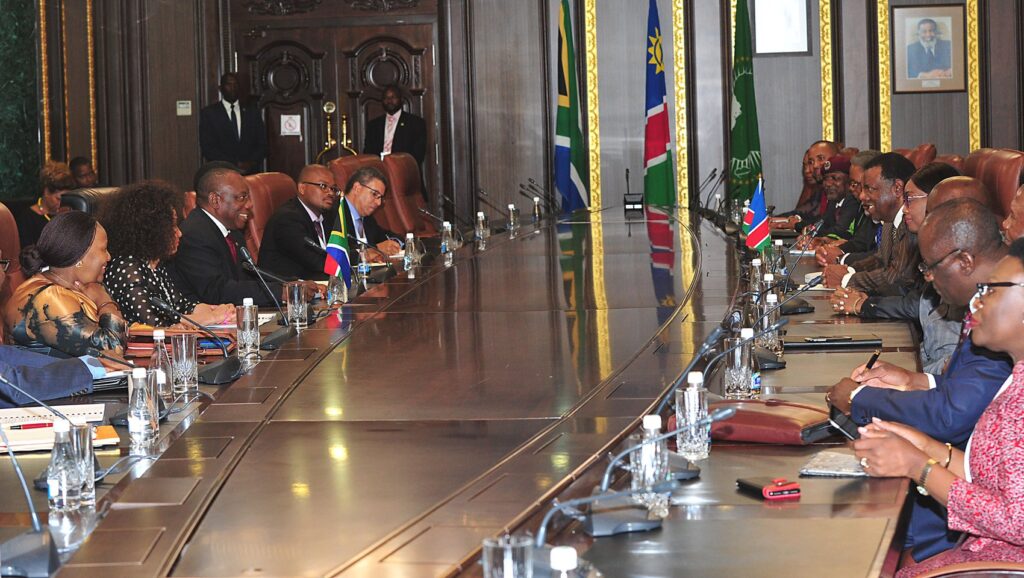
President Cyril Ramaphosa recently completed his first official tour of the Southern African Development Community (SADC) region since becoming South Africa’s fifth president, visiting Angola, Botswana and Namibia. South Africa chairs SADC this year, a …
A stable, affordable energy supply underpins economic development by enabling infrastructure development and investment, and ultimately increases industrialisation and enhances competitiveness. Ensuring electricity security is therefore vital for all c …
This policy brief considers the prospects of the relationship between the AU and the EU maturing beyond the traditional dependency model. Although great progress has been made since the EU was established and its relationship with predominantly ex-colo …
This paper examines the role of the African Development Fund (ADF) in its efforts to support African low-income countries (LICs) in meeting their infrastructure financing needs. African LICs currently face tremendous infrastructure financing gaps, but …
“The BRICS New Development Bank (NDB) is set to issue its first loans in the second quarter of 2016. The bank, the latest addition to the global development finance landscape, was initiated due to a number of factors in emerging economies. One of the k …
“As the New Development Bank (NDB) gears up to extend its first loans in the second quarter of 2016, with its self-stated aim to ‘fund infrastructure and sustainable development projects in BRICS and other emerging economies’, it is important to consid …
“This case study examines the telecommunications sector in Southern Africa and the role that the Communications Regulators’ Association Southern Africa (CRASA)1 plays in encouraging policy harmonisation between member states of the Southern African Dev …
“The Political Economy of Regional Integration in Southern Africa (PERISA) project highlights the ongoing successful areas of trade integration, and examines the reasons for their success. It identifies the actors involved in driving co-operation and i …
“Transfrontier conservation areas (TFCAs) have been established or are under discussion in various locations within Southern Africa. The aim is to have 18 TFCAs in the Southern African Development Community (SADC) in coming years. These areas attempt t …
This paper is based on research conducted recently in South Africa (SA), Namibia, Angola and Botswana. Policy and decision makers were asked to complete a questionnaire about the future of the Southern African Customs Union (SACU). Although the respons …
“A group of Southern African Customs Union (SACU) experts and interested parties recently participated in a scenario-planning exercise on the future of SACU. This paper gives an account of the scenarios developed, which range from SACU collapsing to a …
The aim of the seminar was to examine the relationship between Africa and Europe in the 21st Century, and to investigate whether this relationship is one of habit or is of real strategic importance to both parties. The meeting explored three key issues …
On 11 October 1999 South Africa and the EU signed the TDCA. The agreement was only ratified in May 2004 but some aspects were provisionally implemented with immediate effect. This paper deals with the European Union and its structure and what South Afr …
“This report examines how the Namibian parliament engages with the public in its work and, in turn, how civil society actively participates in the legislative process. In order to gain an understanding of these processes, research in Windhoek and Walvi …
“The process of globalisation is sustained by, and produces, national and regional interdependencies. But in contrast to the Cold War emphasis on regionalism in the form of collective security arrangements, there has been a new emphasis on regional eco …